Dark Knowledge
Purdue Pharma looks toward its rebirth. The Sacklers enjoy their billions. And 200 people still die every day from the epidemic of opioid addiction they created.

Note to readers: The latest in an ongoing series about the Opioid Crisis.

A worried-looking man in his 50s recently arrived to our emergency department by ambulance. The paramedics wheeled his cot in with thinly-contained exasperation. Their handoff to nursing said the patient “fell asleep on the couch holding a drink and then called 911 when he spilt it.” To me, the patient offered a plausible concern that he might have just had a seizure: He’d been watching his grandchild and then woke feeling strange, in a different position on the couch, his drink on the floor, the toddler screaming in fear.
He’d never before had a seizure, but he said he was sure he’d suffered brain damage from abusing opioids. Years ago, he’d hurt his back working as a roofer and was prescribed OxyContin®. Conventional wisdom at that time, ginned up by lying pharmaceutical companies, had held that one would not get addicted to this modern opioid, and so it would be wrong — immoral, even — for a doctor to deny it to a patient in pain. So, he was prescribed a course of opioid addiction. Only for the past few years had he escaped it.
Why would you have brain damage? I asked.
“All of the overdoses,” he replied. He said he’d been revived from some of them at our hospital. (Possibly even by me, although I didn’t remember his face.) “Once, I stopped breathing for seven minutes. It was not good.”
I wondered how he knew it was for seven minutes, but instead of asking, I just agreed with him: “Yeah, that’s not good.” We each nodded regretfully, and I opined that he could indeed have experienced a first-time seizure, as the consequence of a remote anoxic brain injury.
“I’m sure that’s it,” he said. “I haven’t been right since that day. My thinking, I mean.”
The Trump Justice Department let the Sacklers skate
The long, grim saga of Purdue Pharma is coming to an end of sorts, courtesy of a $7 billion bankruptcy deal approved this winter. Some hopelessly doomed appeals have been lodged by a handful of individuals, but the process will start grinding them underfoot this week and conclude at some point in the coming months.
As a footnote, this will also eventually trigger a formal sentencing hearing in the U.S. District Court of New Jersey — the same court where, six years ago, Purdue entered guilty pleas in a non-prosecution deal with the first Trump Administration. That plea deal acknowledged there had been illegal and dishonest work selling opioid addictions, and then Justice accepted a little cash to make the problem go away.
Final approval of that plea deal, as a formality, was linked to the bankruptcy hearing. The deal stipulated that a “Sentencing Hearing Date take place no earlier than seventy-five days following the date of confirmation of the … Purdue Bankruptcy.” So, sometime in March?
I have wistful fantasies of a New Jersey district judge this spring going full Joffrey Baratheon, rejecting the deal and demanding a Sackler head. But that’s unlikely.
Purdue and its Sackler family owners made billions by methodically and scientifically getting ordinary people across the country addicted to opioids; they did this over more than 20 years, despite repeated and serious warnings. The consequences for them? Few worth mentioning.
Sure, over the next 15 years the Sacklers will, per the bankruptcy plan, now have to grudgingly give back some of the billions they’ve gathered. And as a family they’ve been publicly shamed. But they remain billionaires, free to travel the world, apparently unrepentant.
The manufactured epidemic known as the Opioid Crisis was not solely the fault of Purdue & the Sacklers. They were eagerly joined in that lucrative adventure by many, including rival opioid manufacturers like Johnson & Johnson, Mallinckrodt and the infamous Insys (a rare company where the executives did go to jail); pharmaceutical wholesalers like Cardinal Health and McKesson; big-chain pharmacies like Rite Aide and CVS; and various other camp followers, from the McKinsey & Company consultancy, to academic centers like Mass General Hospital and Tufts medical school, to untold numbers of individual physicians who were confused, cajoled and at times even bribed into writing all of those prescriptions.
That said: everyone else was largely an imitator or a facilitator. The spark of genius that lit the flames, and then fanned them furiously ever higher, even as the Feds were closing in, was that of Purdue & the Sacklers. The firestorm of addiction they ignited, for money, has destroyed millions of lives.
Smoldering rage about this casually-engineered catastrophe informs our politics in under-appreciated ways. It feeds into everything: from the suspicion and loathing many feel toward public health authorities and their (our) precious vaccines, to the widespread, sullen indifference about raining Hellfire missiles down on “drug boat people” clinging to wreckage in the Caribbean.
But perhaps better days await? Purdue this year is on schedule to rise from its own ashes and start do-gooding. It will be reborn as Knoa Pharma.
That’s pronounced “No-ah”, if you care. The AI slop-mind says that this name, apparently chosen by Purdue’s enemies, is meant to evoke “knowledge”. Does that mean we’ve learned something?
“Soon, Purdue will cease to exist,” says Purdue’s board chairman in a press release. “Knoa Pharma, a new independent company owned by a foundation, will receive valuable assets and expertise from the old company, and will carry forth.” Its mission: to clean up the mess left behind by Purdue and the Sacklers.
Well, that, and to keep selling OxyContin® for a few more years. Proceeds will no longer go to the Sacklers, but instead to public-service projects dictated by their victorious enemies. (Purdue did not reply to multiple requests for comment.)
Personally, I’d have preferred to see every Purdue building torched to the ground and the earth beneath plowed over and salted. I’d have also welcomed seeing corporate executives and Sackler family representatives do jail time, which is what we usually insist upon when we roll up an organized crime ring that’s killed a bunch of people.
But that’s not how things went.
Five years ago, in the waning days of the first Trump Administration, individual Sacklers paid a mere $225 million to buy off the U.S. Justice Department. That’s pocket change for the crew Justice dubbed “the Named Sacklers”: Richard, David, Kathe, Jonathan and Mortimer. Their family-owned company raked in $34 billion over the years, almost all of it from OxyContin®, and the Sacklers paid themselves fabulously from the proceeds. The family’s estimated worth is north of $11 billion. (Their empire includes, to this day, U.K.-based Mundipharma, which earns far more than $1 billion a year selling OxyContin® in China and other parts foreign.)
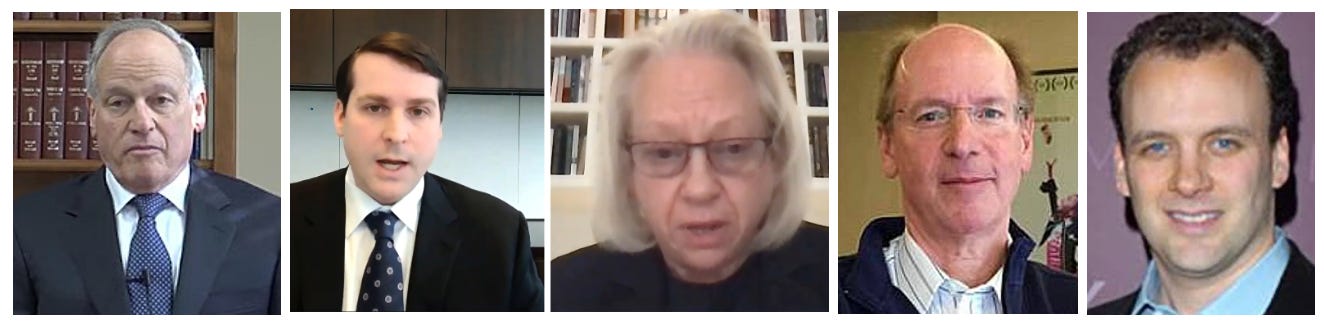
The government says the Sacklers also gutted Purdue in the final years before its 2019 bankruptcy, taking out 75% of revenues a year. The $11 billion the family frantically “milked” (the Supreme Court’s word) out of the company in its dying days came on top of billions paid out in the earlier years.
So, the Justice Department’s $225 million fine — the price the Sacklers paid not to be criminally prosecuted — represented perhaps 1% of the billions the Sacklers have enjoyed.
Put another way, it left untouched 99% of the Sackler family’s ill-gotten opioid gains. But it was enough to resolve Federal allegations that Sackler-run Purdue had made billions illegally slinging dope; and that the Sacklers had then hurriedly siphoned its final billions off in “fraudulent transfers … made to hinder future creditors.”
(The “future creditors” the Sacklers sought to outmaneuver were mostly America’s state and local governments, which had filed hundreds of indignant lawsuits demanding compensation for the suffering and death Purdue had created in their city, town or state; but also many individuals, including more than 130,000 who had filed personal injury claims via Purdue’s bankruptcy proceedings.)
Probably the country would have shrieked in rage if it had understood the Sacklers were escaping prosecution in return for perhaps 1% of their ill-gotten gains. But the Justice Department played us all masterfully, with “but wait, there’s more!” infomercial-style addendums.
Yes, Justice was deferring prosecution in return for a small check, but as Justice explicitly stated, it could also still criminally prosecute everyone involved in this mess. A defiant press release back then stated that “years of hard work by the FBI” had found Purdue & the Sacklers guilty of “illegal and inexcusable activity,” and so Justice reserved the right to bring criminal charges, including specifically against the Sacklers, at any point. (Then why wait? If it was illegal and inexcusable, why excuse it?)
Second, the Justice Department’s announcement touted the Sackler’s personal fines of $225 million but also bandied about various other confusing billion-dollar sums. These totaled a startling $8.3 billion, which Justice claimed Purdue had agreed that it owed the government. But that money was never paid: this Purdue IOU to the Feds was only good for generating self-congratulatory headlines in the day’s news coverage.
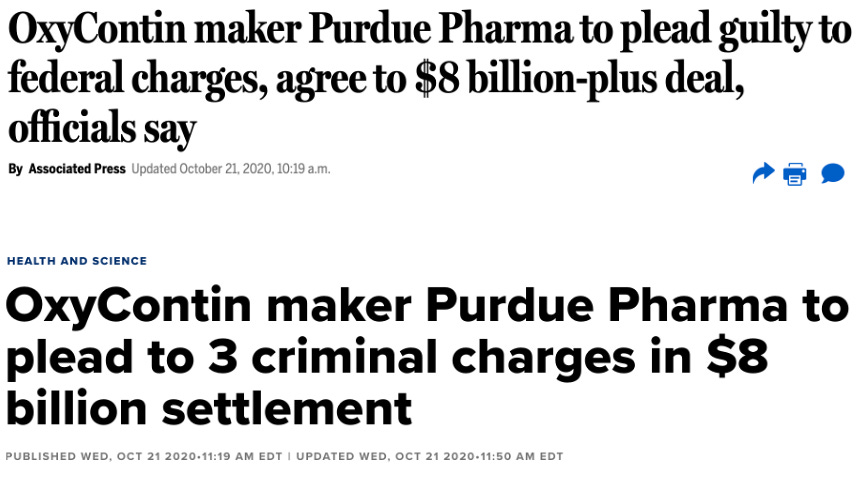
These billions include “the largest penalties ever levied against a pharmaceutical manufacturer,” the Trump 1.0 Justice Department crowed proudly. But once the applause died down, the $8 billion-and-change invoice was folded into the bankruptcy proceeding, where it largely evaporated.
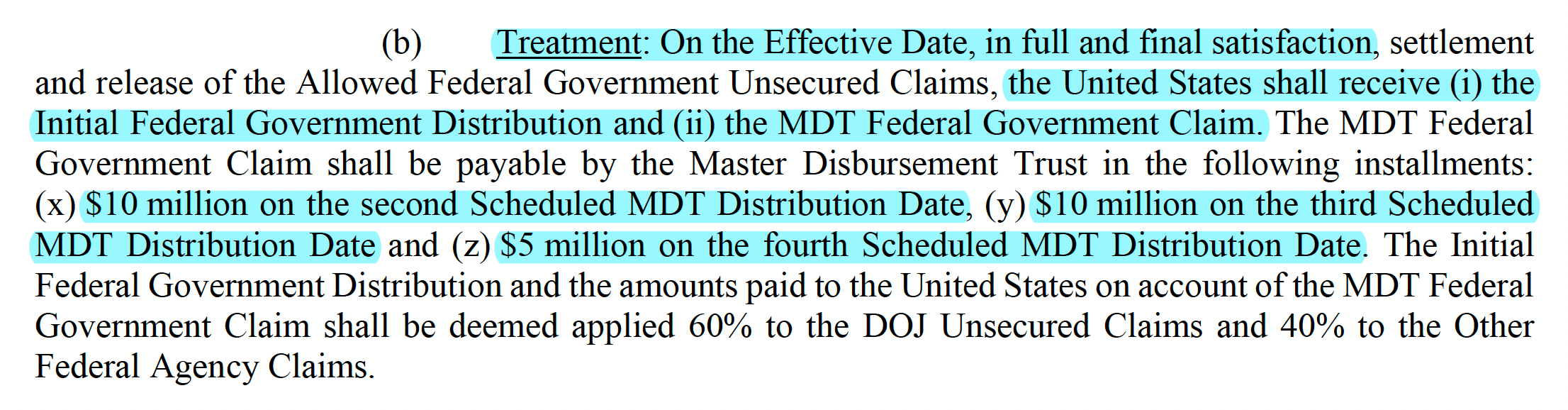
Good luck figuring out what was actually paid to the Feds. By my reporting, and review of the 245-page “18th amended” version of the plan (PDF here), the $8 billion-plus waters down to about $275 million. There’s a $225 million from Purdue to the Justice Department — that must be the standard “make my crime go away, please” fee:

— and then $25 million more upfront —

— and another $25 million on an installment plan.
Finally, the Feds insisted that Purdue, which at that time had just entered the bankruptcy proceedings, would be punitively dissolved.
The company would be destroyed! Cue the celebrations!
Well, no, not “destroyed.” Not exactly. More like “improved.” Post-bankruptcy, the Justice Department said even back then, Purdue would emerge repurposed as “a public benefit company,” one dedicated to tidying up after Purdue’s wild party.
But no one ever went to jail.
True, two Sacklers, David and Kathe, did have to sit through a 2020 Congressional hearing, where they faced bipartisan contempt and rage. They were likened to El Chapo, described as “sickening,” and told by one Kentucky Congressman that there was “no family more evil than yours.” Of course, they didn’t actually have to sit through any of that, because it was the la-la-land of lockdowns, and thus, in honor of COVID-19, this national Congressional hearing was a Zoom call.
In other words: We let the Sacklers keep their freedom and their billions, but we did also yell at them on Zoom.
To be fair, we actually got to yell at them on Zoom twice: The U.S. Bankruptcy Court mediating the battle for Purdue’s assets also made three Sacklers sit through Three Minutes of Hate from ordinary Americans who had lost loved ones to opioids. The Sacklers were not allowed to respond, only to listen as they were called “scum of the earth,” “greedy billionaire cowards,” and so on.
But again, this 2022 hearing was … virtual. Two of the Sacklers listened on Zoom; one, Richard Sackler, got to call in by telephone. The Associated Press studied its computer screen and noted the two observable Sacklers seemed to be listening with neutral expressions. Perhaps they were thinking about how amazingly rich they are.
The death and brain damage goes on
Opioid deaths accelerated dramatically during COVID-19, as did all of the other miseries one might expect from locking people inside their homes. (There was the skyrocketing alcoholism, for example, as well as a “horrifying global surge” in spousal abuse that prompted the United Nations secretary general to call for a “domestic violence ceasefire”.)
Today, as COVID-19 has been downgraded to just-another-flu, opioid overdose deaths have also fallen precipitously. We’re supposed to celebrate this, because we’re back to the “only 80,000 or so” deaths a year we’d been seeing right before the coronavirus pandemic. That’s right, more than 200 Americans die every day of an opioid overdose, and this is progress.
How many more are revived or otherwise survive, but suffer anoxic brain injuries? That, we don’t know. It’s just one more mysterious facet of the ongoing public health crisis that Purdue 1.0 helped create, and that Purdue 2.0 Knoa Pharma is now going to fix for you. Remember to say “thank you”!
Earlier articles in this series:
Part I: A deep dive into the sociopathy of the Opioid Crisis.
Part II: The conspiracy to game the medical literature.
Part III: The conspiracy widens.
Part IV: ‘No family more evil’ fights on
Part V: Welcome to the Tupperware party
I thought the Hulu series Dopesick did a good job of showing the depravity of the Sacklers and the consequences on ordinary people. I’ve watched it twice now, but don’t know if I can watch it again, it’s really depressing. But thank you very much for this series, it’s excellent. We should be throwing Sacklers in prison instead of bombing innocent Venezuelans.
"Personally, I’d have preferred to see every Purdue building torched to the ground and the earth beneath plowed over and salted. I’d have also welcomed seeing corporate executives and Sackler family representatives do jail time, which is what we usually insist upon when we roll up an organized crime ring that’s killed a bunch of people."
Most people would prefer this, I suspect.
Is this sweet heart deal really about protecting just the Sacklers, or the whole rest of the criminal Pharma complex, precedent and all that being crucial to securing further convictions of say, Bourla, for the covid jab fraud?